
Ballyglunin Park House/Blake Estate
Landed Estates of Ireland
The landed estates of Ireland were mostly established by Protestant landowners in the mid to late seventeenth century, on lands confiscated by conquering British forces. This essay will examine how one resilient Catholic family established their landed estate and how they built and expanded it after their arrival. Although the Blakes of Ballyglunin owned land throughout Co. Galway and Mayo, this essay will focus on their Ballyglunin Park estate and its immediate environs, where they remained for over 300 years. I will use a chronological format, detailing how each successor improved their inheritance. The Blake’s of Ballyglunin papers and records can be found in the National Archives of Ireland, the National Library of Ireland, the Hardiman Library in the University of Galway and Galway Co. Council Special Collections.
The Blake family in Galway
The Blakes, a Catholic family of Welsh origin, were settled in Galway in 1277.1 One of the fourteen tribes of Galway, generations of the family flourished in merchant trade and were involved in the governance of the town.2 The Siege of Galway took place from August 1651 to May 1652, during the Cromwellian conquest of Ireland. By the end of 1654 all the leading families in the town, including the Blakes, had been expelled.3
Transplantation
Martin Blake, who had been Sherriff of the Town of Galway 1648-1649, was dispossessed of his Galway Town property by the Cromwellian Commissioners in 1655 and transplanted to rural Cummer, in the Barony of Clare, Co. Galway.4 Having held three houses and ten acres in Galway Town and in excess of 1590 acres in the counties of Galway and Mayo prior to dispossession, he was given 425 acres on 23 May 1656 which was a dramatic loss for him.5 On 3 May 1671 he purchased the Ballyglunin (Ballyglooneen) estate, which was situated close to Cummer, from the Cromwellian planter Charles Holcraft.6 On 26 July 1677, under the Acts of Settlement, Martin Blake obtained a regrant of 1170 plantation acres or 1895 statute acres in the Barony of Clare. These were the lands he was transplanted to plus those that he had accumulated himself in the intervening period.7 In 1677 he was again allowed to purchase a home within Galway town. Martin Blake was involved in at least sixteen land purchases dated from his transplantation to the mid-1680s, including large tracts of land around which the main Ballyglunin estate evolved.8 He consolidated a ten-kilometre triangular holding, the majority of the purchases within the Barony of Clare.9 By 1685 he had accumulated in excess of 2000 acres in Counties Galway and Mayo, a house in Middle Street, Galway and a half interest in three mills in Galway Town which shows his ability to adapt to his situation, to consolidate and to expand.10 On his death in 1691 his son Peter succeeded him, but Peter was to die a month later and he was succeeded by his son Martin.11
The Blakes and the Penal Laws
The Penal Laws, the first of which was introduced in 1695, discriminated against Catholics and served to secure the political, economic, and social ascendancy of Protestants in Ireland.12 These laws dominated Martin’s succession term and prevented any further land purchases. According to the deeds on record there is a gap in purchases by the Blakes from 1681 to 1789.13
Securing and Maintaining the Estate
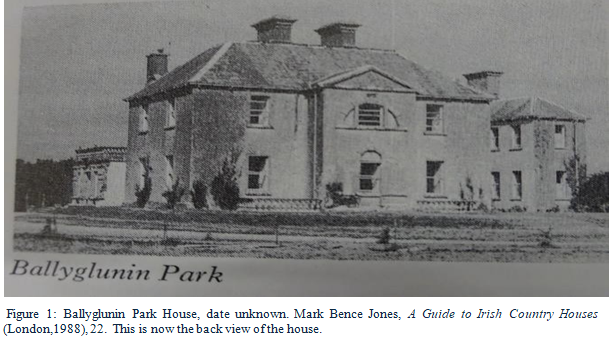
Expanding the estate then, was not an option for Martin, rather securing and maintaining it was his priority. Ballyglunin Park House, seen in Figure 1, situated on the 427-acre Ballyglunin (Ballyglooneen) estate on the banks of the Abbert River, was built by Martin in 1730 on the site of an earlier medieval castle. It featured salvaged components of this earlier structure. It was a modest two storey house with three bays, built during Penal times to look as unassuming as possible.14
Edmond Blake inherits Estate
Edmond Blake inherited in 1737 after the death of his father Martin.15 According to account books available, sheep farming and wool selling made up the largest part of his agricultural income as well as rental income. Other income came from money lending, ‘their bonds were passed around as good as paper money’, with a steady income from interest payments, mortgages, and foreign trade which was both a source of income and an outlet for agricultural produce.16 Edmond slowly increased the acreage held by taking out leases and numerous surveys of their land were done. Edmond retired in 1765 and his son Martin bought out his father’s stock which included an extensive 3241 sheep and took over his leases.17 Account books detail improvements such as bridge building, extensive wall building in the estate by stonemasons, drainage and reclamation of the land.18 In 1769 Martin Blake and his son Edmond made a submission to the Papal Court ‘inquiring as to whether, in view of the situation of Catholic proprietors under the Penal Laws, he ought to sell his estate and emigrate’. The answer received was that there was no obligation to do so.19 Martin died in 1777 and his son Edmond inherited, passing away five years later in 1782, the year the Penal Laws ended.20 The family could now purchase land again. Edmond’s minor son Martin Stephen inherited but died aged seven years in 1788 and his uncle Walter Blake, who died in 1802, succeeded.21
Martin Joseph Blake
Martin Joseph Blake succeeded from his father Walter in 1802. He would run the estate for almost fifty years. In 1803 John Blake, Ballyglunin Park, a son of Martin who died in 1777, married his near neighbour Olivia Ann, daughter of Christopher French and heiress of Brooklodge Demesne.22 In 1808 the lease for Brooklodge was bought from the Skerritt family by Thomas Hynes and in 1813 he sold the lease to Martin J. Blake of Ballyglunin for £10,000.23
Brooklodge Demesne
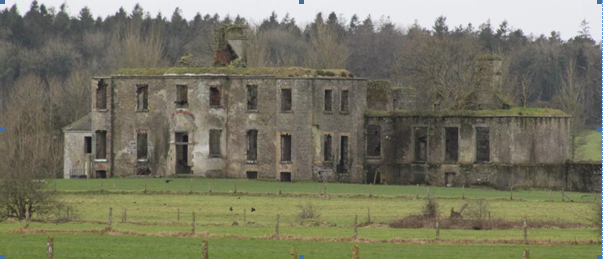
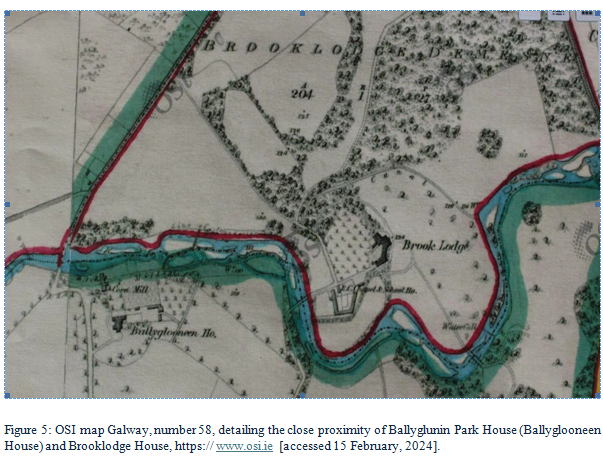
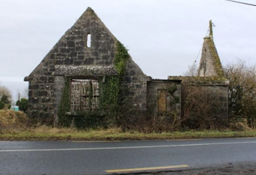
Brooklodge Demesne consisted of 292 acres north of the Abbert River. Brooklodge House, seen in Figures 2 to 5, replaced the adjacent old house known as Ballyglunin Castle which had been built in the 13th Century. The building of Brooklodge House was commenced in 1775 by Christopher French, a Protestant, who held a lease on the property. It took thirty years to complete the building of the elaborate detached five-bay two storey villa with a central bow on two principal fronts, to develop the estate and plant the woods including a deer park, at a total cost of £11,084. It included extensive outbuildings, racing stables, a school, a church, an icehouse and boundary walls.24
Ballyglunin Park House
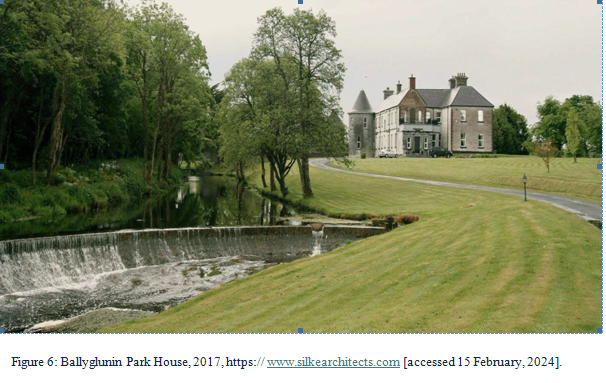
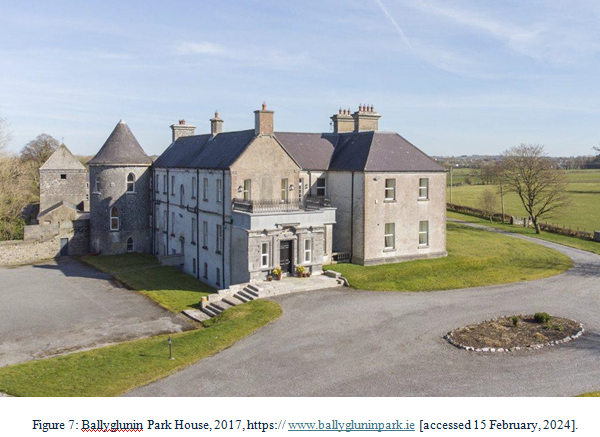
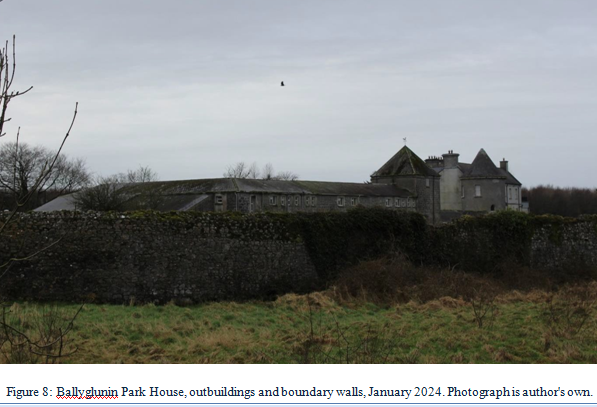
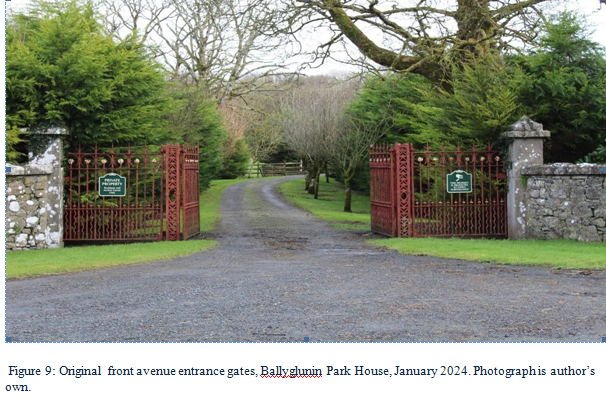
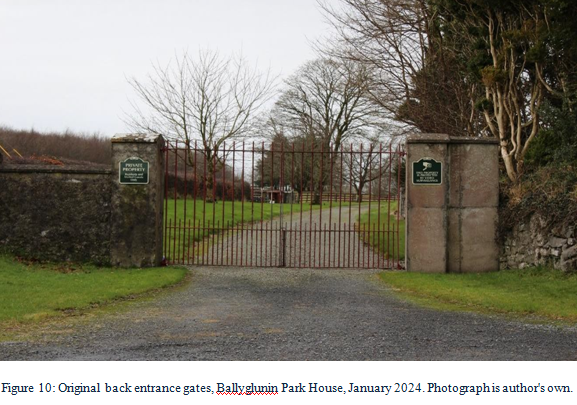
Ballyglunin Park House, seen in Figures 6 to 10, which had been built as a Georgian Manor house in 1730, had a Victorian wing, castle tower, walls and moat added to it in the 1820s.25 Martin J., who was a skilled engineer by profession, installed a turbine in the Abbert River to supply piped water to his house and also diverted the course of the river to create a waterfall located forty meters from the main house, the aesthetic beauty of such a feature adding to the image he wanted to portray.26 ‘This country house is notable for its two phases of building and reorientation of its entrance. It’s setting is enhanced by the associated outbuildings and walled garden, and its siting next to the Abbert river’. 27
Fransiscan Brothers gifted a portion of land
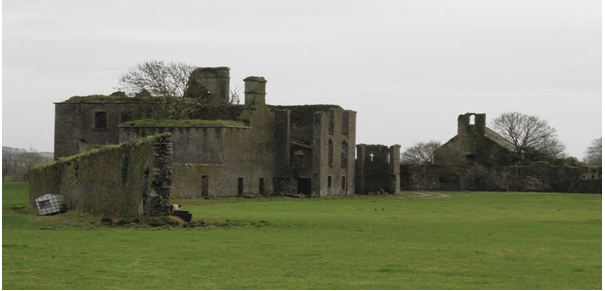
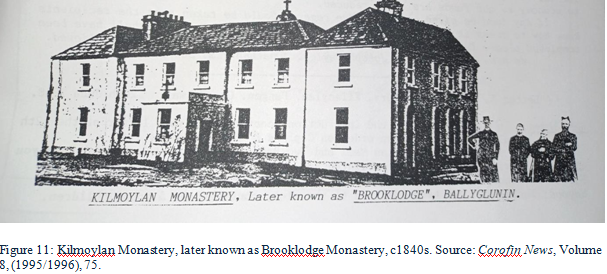
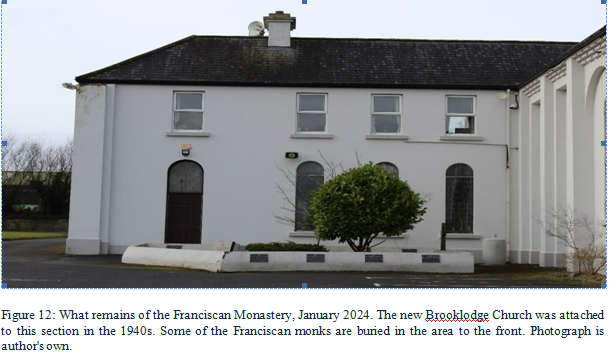
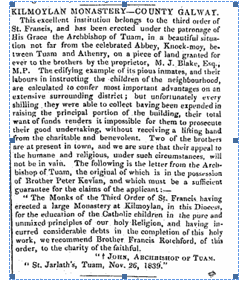
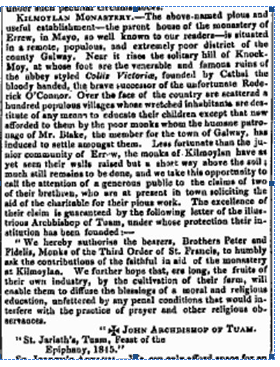
In 1834, five years after the Catholic Emancipation Act of 1829, Martin J. Blake gave sixteen acres in Brooklodge to the Franciscan Brothers to erect a Franciscan Monastery, seen in Figures 11 and 12, to educate the children of the parish (see Appendix A).28 On 30 August 1838 the foundation stone was laid by Martin J. Blake and the Monastery was dedicated to the Immaculate Conception by Archbishop McHale, Tuam. The school opened in 1839 and would later, by way of an extension to the Chapel, be capable of providing for 200 pupils. By 1842 the chapel was completed. In 1844 a large road gate façade was built. The people of the area attended services in the small chapel attached to the Monastery. The Blakes, although they had their own private chapel on their estate, attended mass there every Sunday.29
R.I.C. Barracks established near the Estate
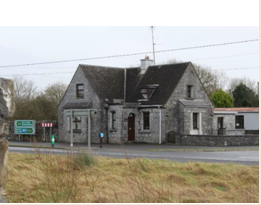
Also, in 1834 Martin J. established an R.I.C. Barracks convenient to the entrance gates at the eastern end of his front avenue which enhanced his own security.30 In 1847, during Famine times, a number of trees were planted in the Ballyglunin estate by Ballinasloe Nurseries at a cost of five pounds and ten shillings. Some of these trees are still to be observed along the front avenue leading into the house.31 Gate Lodges, as seen in Figures 13 and 14, were built near at least two avenue entrances to the property c1830s.32
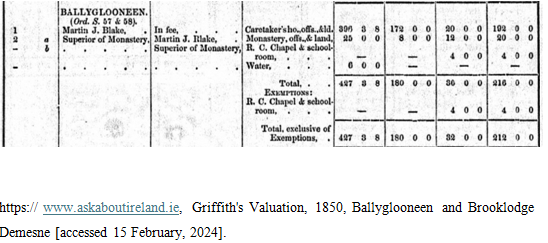
In 1853 the Ballyglunin Park Post Office, of which Martin J. was the guarantor, was built at the avenue entrance to Brooklodge House, close to the R.I.C. Barracks and on the main coach road mid-way between Tuam and Athenry. It would later be changed to a new site near the Railway Station (see below) at a back entrance to the Blakes home.33 The 1850 Griffiths Valuation for the area valued Ballyglunin Park at £212 and Brooklodge Demesne at £126 (see Appendix B).34
Committee formed to promote and build an Athenry to Tuam railway
In 1854 Martin J. Blake, and others, formed a committee to promote an extension of the Dublin to Galway railway and build an Athenry to Tuam railway which would be built on land given at discounted rates by many of the committee members, including himself. In 1858 they sponsored a Bill which was passed in the House of Commons, London, to establish this railway which was financed by the selling of shares (see Appendix C).35
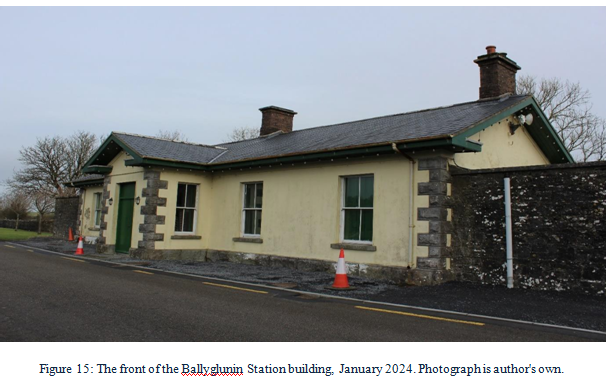
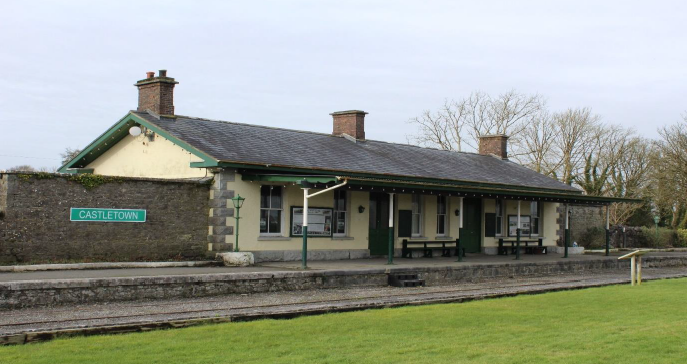
Originally it was proposed to run the line from Athenry to Monivea and from there to Tuam, but Martin J. Blake used his influence as an M.P. for the Borough of Galway to have the route altered to pass through Ballyglunin.36 This would facilitate the movement of grains, beets, cattle and heavy goods through his own back yard. The track was completed on 19 September 1860 and a week later regular services commenced on the line. In November 1860 the Ballyglunin train station, seen in Figures 15 to 17, a single 225-foot platform at the time, opened for passenger traffic.37 Martin J. Blake died unmarried in 1861 and was succeeded by his nephew Walter Martin Blake.38
Walter Blake
After Martin J.’s death the interest in the lease of Brooklodge Demesne was offered for sale by auction in October 1862 (see Appendix D).39 The advertisement stated that since it had been taken over by Martin J.
… the lands have been well enclosed, and sub divided, and the natural course of a river has been diverted and run through part of the property, with a fall from thence to the sea, whereby the salmon come up in great numbers occasionally, and a quantity of land, hitherto subject to frequent flooding, is now gained. The property is in the midst of a sporting country which is hunted by two packs of hounds. The Athenry and Tuam Railway now intersects it, with the Ballyglunin Station thereon, within ten minutes’ walk of the mansion. There is a great deal of timber, both young and old, now growing on the Demesne. 40
The lease appears to have remained unsold and an Encumbered Estates advertisement for Walter Blake in 1867 offered twelve lots for sale, most of which were located in Galway Town, and two lots of which included the lease of the lands and Mansion House of Brooklodge, ‘which by some outlay could be made suitable for a gentleman’s residence’, which suggests it may have fallen into some disrepair (see Appendix E).41 The lands however remained the property of the Skerritt’s and leased by the Blakes. By 1909 the house and land would be owned in fee by John Blake (see below).42 In 1876 Walter M. Blake was listed as owning 10,336 acres of land in Co. Galway valued at £3330 and another 116 acres in Galway valued at £638.43 Walter died in Switzerland in 1891. He had run the Ballyglunin estate for thirty years. An Obituary in the Tuam Herald estimated his estate to be ‘very little short of a quarter of a million of money’.
Robert Blake
Robert Blake, a brother of Walter who died unmarried, received Walter’s landed estates after his death in 1891.45 Robert had been living in Brooklodge since 1868 but moved into Ballyglunin Park House in 1891 after inheriting.
‘The Catholic Blakes of Ballyglunin had an income of £20,000 in the late 19th century. Less than half of the Blakes income was from rent. The Blakes were shrewd investors and were creditors to many less well-off landowners, and by being unmarried in two successive generations they were saved the heavy expense of portions and jointures’.46
Robert died in April 1917, having sold 9800 acres of the ancestral estates and those at Ballyglunin to the Congested Districts Board for £60,000, retaining some of the lands around the family mansion at Ballyglunin.47
John J. Blake
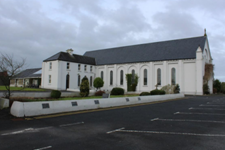
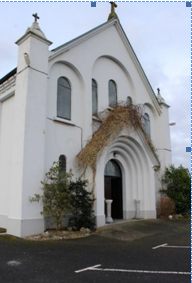
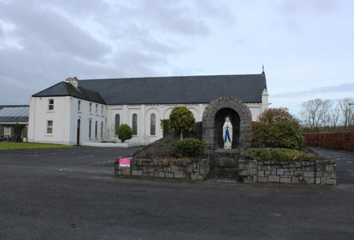
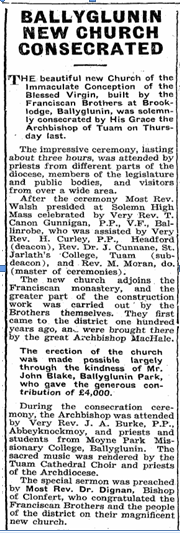
Robert’s son John J. Blake succeeded him.48 The building of the Church of the Immaculate Conception, Brooklodge, Ballyglunin commenced in 1941, an extension of the Monastery Chapel built by the Franciscan brothers.49 The foundation stone was laid in May 1943, and the building, assisted by John J. Blake, an engineer by profession, was completed by March 1944. The church was consecrated in 1949 (Figures 19 to 22). It was a simple rectangular shape reinforced on each side by concrete pillars with tall slender Romanesque style windows in between each pillar.50 John J. Blake gave an initial substantial grant of £1000, and the sand and gravel used were free from his pits in Ballyglunin Park. To help clear the final debts John J. Blake gave a further donation of £4000 with a request to be buried in the Monastery grounds and a grotto erected in his memory.51 This Grotto, seen in Figure 21, was erected in 2009, on the Diamond Jubilee celebration of the Church.52
The Blakes leave Ballyglunin
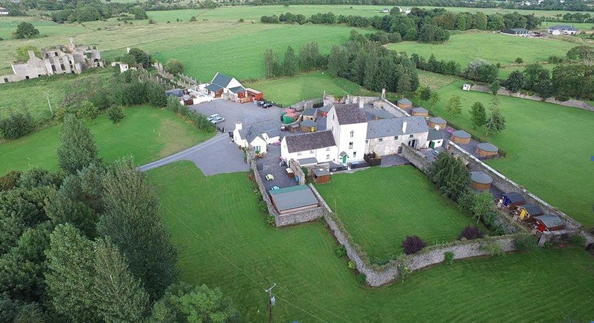
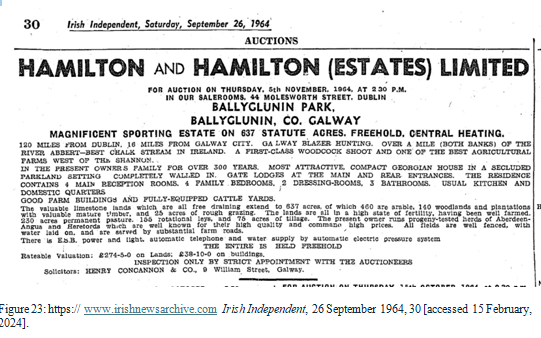
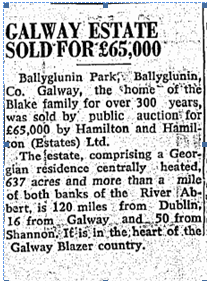
John J. died in 1952 and was succeeded by his son Acheson (see Appendix H).53 Ballyglunin Park House and lands, as seen in Figures 23 and 24, the home of the Blake family for over 300 years, was sold to the Land Commission in 1964.54 The Land Commission sold the house to Opus Dei in 1965 to be developed into a conference centre and hotel training school. The lands were sold to locals.55
Today, despite the fact that the Blakes themselves officially left the area in 1964, locals still go for a walk ‘around Blakes’. The ruins of Brooklodge remain and Galway Glamping run a business in the old outbuildings, school and grounds.56 Ballyglunin Park House remains, bought and renovated by its current owners in 2017, and is rented out as exclusive accommodation.57 Ballyglunin Station closed to traffic in 1979 but renovations are now ongoing, and the buildings are used by the community and as a visitor attraction.58 John J. Blake and his wife are buried in the Franciscan Brothers graveyard at Brooklodge Church, and the Grotto remains in his memory.59 The Franciscan monks left in 1989, their premises were sold to the HSE who demolished part of the buildings and rebuilt spaces for Ability West to operate nurseries there.60
Conclusion
This essay has demonstrated how the Catholic Blakes of Ballyglunin were able to consolidate and expand their estate after their transplantation and how they built up their immediate environs for their own advantage and for the local Catholic community. They built Ballyglunin Park House, leased and later bought nearby Brooklodge House and Demesne, built Gate Lodges, a Franciscan Monastery, R.I.C. Barracks, Post Office, Train Station and a Catholic Church, all of which demonstrates their attachment to the area and their plans to remain. The Blakes arrived, built and remained in Ballyglunin for over 300 years and have left a lasting legacy in the area.
1https:// www.archive.org, Martin J. Blake, Blake Family Records 1600-1700, (London, 1905), 230-231 [accessed 15 February, 2024], https://www.burkeseastgalway.com/Blake [accessed 15 February, 2024], Patrick Melvin, Estates and Landed Society in Galway (Dublin, 2012), 387.
2 James Hardiman, Hardiman’s History of Galway: The History of the Town and County of the Town of Galway
(Dublin, 1820), Bicentenary Edition 2020, 6-8, 21.
3 Hardiman, Hardiman’s History of Galway, 2020 edition,144-146.
4 Blake, Blake Family Records, 214-217 [accessed 15 February, 2024].
5 Blake, Blake Family Records, 214 [accessed 15 February, 2024], https:// www.academia.edu, Patrick Walsh, The Blakes of Ballyglunin: Catholic merchants and landowners of Galway town and county in the seventeenth and eighteenth centuries, (Dublin, 2017), 31-33 [accessed 15 February, 2024].
6 Blake, Blake Family Records, 214 [accessed 15 February 2024], Walsh, The Blakes of Ballyglunin, 56-57 [accessed 15 February, 2024]. Ballyglooneen, also known as Kilmoylan at the time, now Ballyglunin, was situated in the County of Galway, in the Barony of Clare, in the parish of Kilmoylan. Today it is situated off the N63 on the Roscommon road between Tuam and Abbeyknockmoy.
7 Blake, Blake Family Records, 214 [accessed 15 February, 2024].
8 Walsh, The Blakes of Ballyglunin, 55 [accessed 15 February, 2024].
9 Walsh, The Blakes of Ballyglunin, 55 [accessed 15 February, 2024].
10 Walsh, The Blakes of Ballyglunin,54,79 [accessed 15 February, 2024].
11 Blake, Blake Family Records, 214-217 [accessed 15 February, 2024].
12 https://www.irishidentity.com [accessed 15 February, 2034], Walsh, The Blakes of Ballyglunin, 10-11 [accessed 15 February 2024]. The Penal laws included curtailing Catholic rights to exercise their religion, to receive an education, to engage in trade or commerce, to own or lease land for longer than thirty-one years, and the 1703 Popery Act forbade inheritance by the eldest son only, rather the laws required that the estate be inherited by all sons equally.
13 Walsh, The Blakes of Ballyglunin, 64-65 [accessed 15 February, 2024].
14 Mark Bence Jones, A Guide to Irish Country Houses, (London, 1988), 22, Walsh, The Blakes of Ballyglunin, 85 [accessed 15 February, 2024]. A photograph of Ballyglunin Park House, c1890, is listed as being amongst the Blake of Ballyglunin papers, 1840-1920, MS 27,011, at the National Library, Dublin. However, when this author ordered this item for viewing, along with maps in MS 27,001-27,011, folder vtlsooo831172, the archivist was unable to locate same.
15 Blake, Blake Family Records, 214-217 [accessed 15 February, 2024].
16 Walsh, The Blakes of Ballyglunin, 92-94,97 [accessed 15 February, 2024].
17 Walsh, The Blakes of Ballyglunin, 92-94 [accessed 15 February, 2024].
18 Walsh, The Blakes of Ballyglunin, 92-97 [accessed 15 February, 2024].
19 National Archives Ireland, Ballyglunin Papers, Documents concerning the Blake Family and their property in Co. Galway, principally in and near Ballyglunin (Barony of Clare), re M6935, Parcel 31, (4)-(7), 47. (Dublin, Unknown publication date), Galway Co. Libraries H.Q., 929.2.
20 Blake, Blake Family Records, 214-217 [accessed 15 February, 2024], https:// www.irishidentity.com [accessed 15 February, 2024].
21 Blake, Blake Family Records, 214-217 [accessed 15 February, 2024].
22 https:// www.landedestates.ie [accessed 15 February, 2024], Killererin Heritage Society, Killererin, A Parish History (Galway, 2015), 611-612.
23 https:// www.landedestates.ie [accessed 15 February, 2024], Unknown author, ‘A Brooklodge Auction Handbill (1862)’, Journal of the Old Tuam Society, Volume 12, (2015), 80, Melvin, Estates and Landed Society, 90.
24 Walsh, The Blakes of Ballyglunin,109 [accessed 15 February, 2024], Tom Keating, ‘Some Ballyglunin Gleanings’, Corofin News, Volume 4 (1991), 20-23.
25 https:// www.ballygluninpark.ie [accessed 15 February, 2024].
26 Keating, ‘Some Ballyglunin Gleanings’, 20-23.
27 https:// www.buildingsofireland.ie [accessed 15 February, 2024].
28 https:// www.irishidentity.com [accessed 15 February, 2024], Sean Cunningham, ‘The Franciscan Brothers Monastery of the Immaculate Conception at Brooklodge, Ballyglunin,1834-1980’, Corofin News, Volume 3, (1990), 35-40.
29 Cunningham, ‘The Franciscan Brothers Monastery’, 35-40.
30 https:// www.garda.ie/our history [accessed 15 February, 2024], Doreen Cunningham, ‘Annagh Schoolgirls Local History Story’, Corofin News, Volume 7, (1994), 24.
31 Melvin, Estates and Landed Society, 90, Unknown author, ‘The History of Ballyglunin Estate’, Chapter 4, (1993), photocopy of a typed article, Tuam Library, 941.74.
32 Keating, ‘Some Ballyglunin Gleanings’, 20-23.
33 Marie Mannion, ‘The Post Office, Ballyglunin, Belclare, Cummer, The story from the beginning’, Corofin News, Volume 9, (1996/97), 26-27.
34 https:// www.askaboutireland.ie/griffith- valuation/Ballyglooneen/Galway/Barony of Clare/Parish of Kilmoylan [accessed 15 February, 2024], https:// www.askaboutireland.ie/griffith-valuation/Brooklodge Demesne/Galway/Barony of Clare/Parish of Killererin [accessed 15 February, 2024].
35 https:// www.irishnewsarchive.com, Tuam Herald, 26 December 1857, 2 [accessed 15 February, 2024], Sean Cunningham, ‘Ballyglunin Station’, Corofin News, Volume 11, (1998/1999),12-15.
36 Michael J. Hurley, Ballyglunin Station ‘Castletown’, (Galway, 2021), 21, https:// www.ballyglunin.com [accessed 15 February, 2024].
37 Hurley, Ballyglunin Station, 23, Cunningham, ‘Ballyglunin Station’, 12-15, https:// www.ballyglunin.com [accessed 15 February, 2024].
38 Blake, Blake Family Records, 214-217, [accessed 15 February, 2024].
39 https:// www.irishnewsarchive.com, Tuam Herald,16 August 1862, 3, [accessed 15 February, 2024].
40 https:// www.irishnewsarchive.com, Tuam Herald, 16 August 1862, 3, [accessed 15 February, 2024].
41 https:// www.irishnewsarchive.com, Freeman’s Journal, 23 February 1867, 2, [accessed 15 February, 2024].
42 Killererin Heritage Society, Killererin A Parish History, 655.
43Walsh, The Blakes of Ballyglunin, 200, Melvin, Estates and Landed Society, 61, 450-453, https:// www.failteromhat.com/lo1876.htm [accessed 15 February, 2024].
44 https:// www.irishnewsarchive.com, Tuam Herald, 3 October 1891,2 [accessed 15 February, 2024].
45 Blake, Blake Family Records, 214-217 [accessed 15 February, 2024].
46 Melvin, Estates and Landed Society, xix, 177.
47 https:// www.irishnewsarchive.com, Tuam Herald, 14 April 1917, 1 [accessed 15 February, 2024].
48 Blake, Blake Family Records, 214-217 [accessed 15 February, 2024].
49 Brooklodge Pastoral Council, Souvenir Booklet of Diamond Jubilee Celebration of Brooklodge Church, (Galway, 2009), 2-4.
50 Brooklodge Pastoral Council, Souvenir Booklet, 2-4, https:// www.irishnewsarchive.com, Irish Independent, 9 September 1949 [accessed 15 February, 2024], Sean Cunningham, ‘The Church of the Immaculate Conception, Ballyglunin, Co. Galway’, Corofin News, Volume 12, (1999-2000),13-17.
51 Brooklodge Pastoral Council, Souvenir Booklet, 3-6, https:// www.irishnewsarchive.com Tuam Herald, 17 September 1949, 5 [accessed 15 February, 2024].
52 Brooklodge Pastoral Council, Souvenir Booklet, 1-16.
53 Blake, Blake Family Records, 214-217 [accessed 15 February, 2024], https:// www.irishnewsarchive.com,
Tuam Herald, 26 January 1952, 5 [accessed 15 February, 2024].
54 https:// www.irishnewsarchive.com, Leitrim Observer, 21 November 1964, 3 [accessed 15 February, 2024].
55 https:// www.irishnewsarchive.com, Irish Independent, 7 March, 1966, 11 [accessed 15 February, 2024].
56 https:// www.galwayglamping.ie [accessed 15 February, 2024].
57 Ballyglunin Station closed to traffic in 1979 but renovations are now ongoing, and the buildings are used by the community and as a visitor attraction.
58 John J. Blake and his wife are buried in the Franciscan Brothers graveyard at Brooklodge Church, and the Grotto remains in his memory.
59 The Franciscan monks left in 1989, their premises were sold to the HSE who demolished part of the buildings and rebuilt spaces for Ability West to operate nurseries there.
60 Ballyglunin Post Office closed in 2019.
61 https:// killererin.galwaycommunityheritage.org [accessed 15 February, 2024].

Comments about this page
Fabulous article on an important part of Killererin’s history. Great research Catherine
Add a comment about this page