
Jack Boyle's Forge, Dangan
How it began
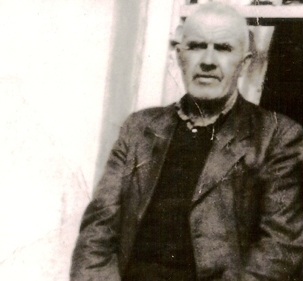
The forge in Dangan was set up by the last Jack Boyle who was born in 1901 and the son of Martin Boyle and Mary Kemple. He was the second eldest of a family of ten. From a young age he was good with his hands and had an interest in working with steel so at the age of 16 he started his apprenticeship with Michael Ryan, a blacksmith from Cloonkell, Clonberne. which lasted 5 years.
Lucky to be alive
During that time an incident took place at Ryan’s which left him lucky to be alive. The Black and Tans were roaming the countryside and one day a lorry load of them passed by the forge. John was watching from the door and on seeing him they backed up, came in and grabbed him. They forced him to jump from the nearby bridge into the river below. Shots rang out but miraculously he escaped the bullets and did not drown.
Setting up his own forge
When he finished his apprenticeship, he came home to Dangan to set up his own forge which consisted of a hearth made of a block of concrete with a shallow centre to hold the fire. It had a tank of water at one end for cooling the steel and a bellows was fitted at the other end. The function of the bellows was to blow and boost the fire. It was worked manually by pulling on the rope attached to it. Most of the time, blacksmiths had an assistant to do this. The fuel for the fire was coal dust. His other implements were an anvil, hammers, sledges, a vice and a manually operated drill.
A forge by day ….
The anvil was made of steel with a flat top and rounded to a point at one end. This was used to shape and mould the steel into any desired shape. The steel had to be red hot to do this. Jack had a saying “striking cold iron is labour in vain”. The forge was a hive of activity during daylight hours and in the evenings, a meeting place for all the local men, while he worked on. Sometimes they took a hand to the sledging.
Jack had a way with horses
Jack had no fear of the horses whether they were wild, wicked or flighty. He had a way of controlling them by tying a rope around the horse’s lower lip and winding it tightly with a wooden peg. This was called “the touch”. Sometimes horses’ feet might need correction as they were not walking straight. This he did, by putting a raise on one side of the shoe to stop them turning in or out. Blacksmiths had to make all their own tools. In the war years, steel was very scarce, so the horse shoes had to be made from worn horse cart steel tyres on the wooden wheels. In later years, the shoes could be bought ready-made. When shoeing the horses in winter, he fitted studs on the shoes to give the horse a grip on slippery roads. Shoeing horses was just one part of his job. He also did all the repair work on all the farm implements.
Repairing farm implements
A few examples were for instance, the horse plough had a part called the coulter, which became worn over time, so an extension had to be welded on. The coulter was used to cut the sod before turning it over. The equivalent today would be the discs used in tractor ploughs. The harrows were next. The springtooth ran on sole plates which had to be taken out and pointed every so often. The timber harrows used for sowing grain had steel pins which had to be taken out and pointed ever so often. There was also another implement called a scuffler. This was used to loosen the weeds and the soil in the potato drills before they were moulded, which was done with the drill plough, repointing the drill with new soil. The scuffler had three to five so-called paws. These had to be replaced every so often.
Making steel tyres
Another job the blacksmith had, was the fitting and refitting of steel tyres on the wooden wheels of the horse and donkey carts. The refitting had to be done because, after a number of years of work, the tyre became loose and fell off. Before this job started, the owner of the cart had to supply a load of good quality turf as a huge fire was needed. In a field close to the forge, there was a circular concrete base to hold the timber wheel flat. The fire was lit close by, ahead of the job being done. The correct size needed was obtained by measuring the outer circumference of the timber wheel and the inner circumference of the steel tyre. A small wooden wheel with a handle was used to do this measurement. It had to be exact as the steel tyre had to be one to two inches smaller in circumference than the wooden wheel.
The tyre would then be cut and welded. The welding was done by the heat of the fire in the forge. The steel was reddened in the fire until it reached melting point, then the two pieces were tapped together. Now it was ready for refitting to the timber wheel. It was brought out to the fire in the field and completely covered with red hot coals until it too became red, causing it to expand to an inch plus. It was then lifted with special handmade tools and dropped over the timber wheel on the concrete base. It had to be cooled immediately by pouring water on it to retract the expansion until it became tight on the wheel. Normally two tyres would be fitted at the one time. This was considered a fairly big job in those days.
A variety of jobs
The blacksmith did many more jobs, too numerous to mention, but one in particular was the making of sheep brands which identified the name of the owner, such as JB for Jack Boyle.
Modern machinery takes over
The forge continued to function as it had done up to approximately 1965, when tractors and modern machinery began to replace the working horse.
No Comments
Add a comment about this page