
Famine in Killererin
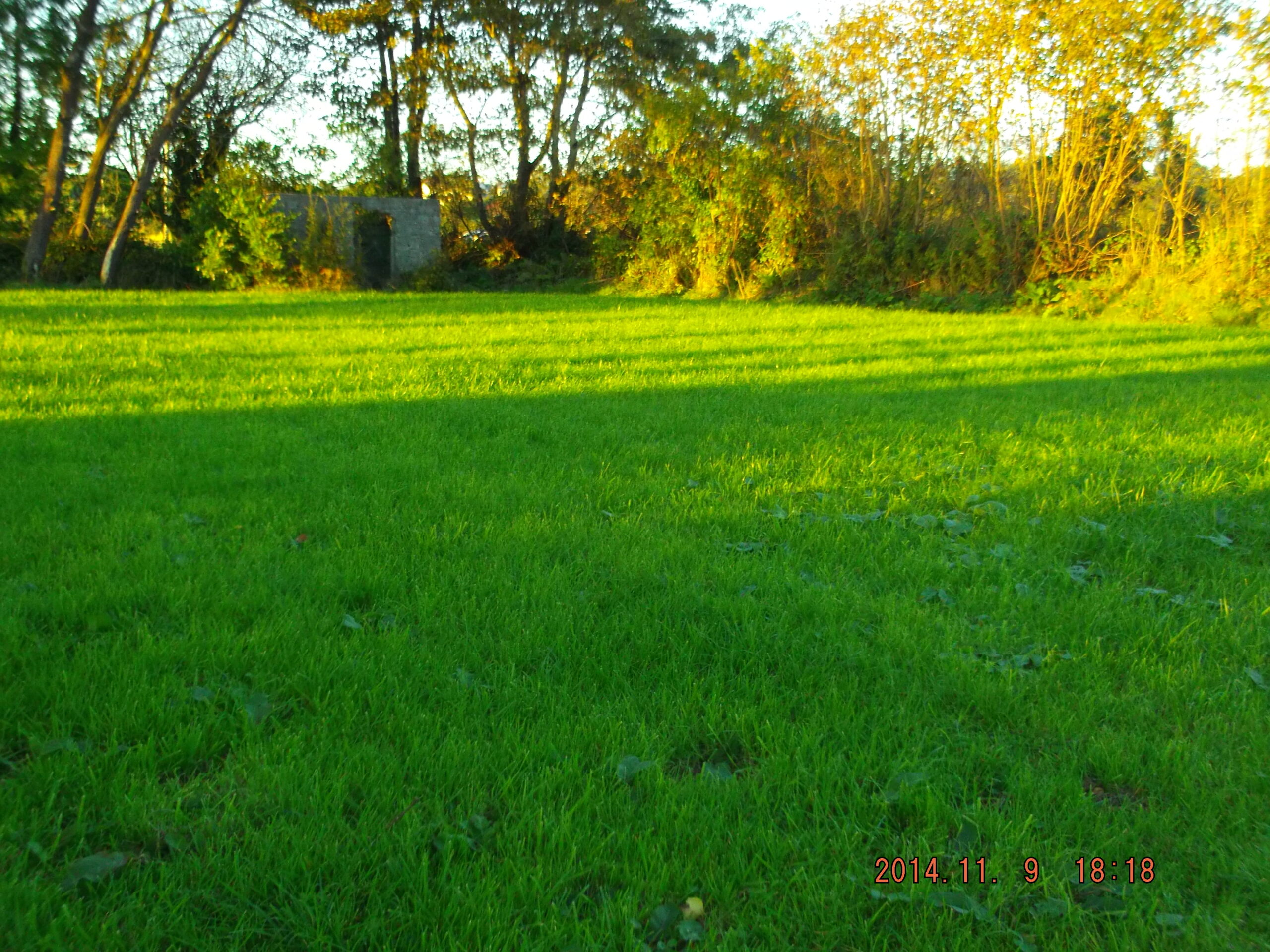
![Former Synge Family Farm and ‘Famine Field at Peak’[3]Famine Field, Peak, which has not been ploughed for over 100 years. | Brid Fahy, Peak](https://dpdgay9x1sxad.cloudfront.net/wp-content/uploads/sites/11/2026/05/Famine-Field-Peak-002-1-374x281.jpg "Famine Field Peak 002 (1)")


‘Bereft of home, and kith and kin –
With plenty all around –
I starved within my cabin,
And slept upon the ground’
Charles J. Kickham, The Glen of Aherlow
Famine in Killererin
The famine of 1847 was not the first to ravage the country. Throughout the 1700s the country experienced a number of famines. The failure of the potato crop and the scale of distress, sickness and death experienced during the 1840s led to the famine of 1847 to become known as “The Great Famine” (or An Gorta Mór in Irish) and it was one of the most devastating experiences of that period. A later famine event occurred in the 1880s and again plunged the west of Ireland into a period of distress and hunger.
The Famine in the West
On 16th July 1842 the Freeman’s Journal reported correspondence between Archbishop John McHale and Lord Eliot using testimony of the Registered Magistrate for Tuam, Mr. Tomkin Brew Esq., seeking recognition by the British Parliament of the existence of famine in the area:
‘If one penny were to purchase a meal, hundreds could not procure that penny or labour to procure it. It is my solemn belief founded on their wasted visages, there are at this moment more than one thousand individuals whose brave existence for entire days is kept up merely by the thinnest sparkling of meal in messes of noisome vegetables’[1]
The town of Tuam
By January 1847, the town of Tuam was experiencing deaths by starvation and the spread of fever. The paper reported that ‘… in the Tuam Workhouse 77 people were down with fever and many more were down with dysentery and dropsy’.[2] The photograph to the right, taken in Killererin, shows a field where reportedly a 16 year old girl died from starvation. No one can say for sure if the girl was a local or from outside the Parish. It is said that the field hasn’t been tilled or ploughed in over 100 years.
Famine and Plenty living side-by-side
While an abundant harvest was expected for 1847 and indeed The Tuam Herald reported that ‘the Tuam area has avoided the extreme ravages of the famine during the last half of the year[4] by February 1848 ‘at least 2,000 unfortunate beings were from an early hour in front of the Tuam Union Work house in the hope of getting admission… there are now 5,000 receiving relief in and out of the workhouse and fully 20,000 more in wait’.[5] Contradictions like this were evident throughout the reporting of the Famine. For example, on 2nd October 1845 the Freeman’s Journal reported on a cattle show in Ballinasloe where ‘…300 Gentlemen sat down at a banquet comprising all the choicest viands and the rarest delicacies of the sea and the wines including champagne and claret were the richest vintage and choicest aroma’.[6] As is often the case famine and plenty reigned side by side.
Failure of Potato crop
In 1846 almost the entire potato crop failed. In 1847 only 2 million tons were harvested whereas 15 million tons were harvested in 1845.[7] By July 22nd 1848 the failure of the potato crop was once again reported in the papers and evictions were also becoming a typical sight on the Dunsandle estate around Athenry as ‘all who can fly are emigrating fast from the country’[8]
Emigration or the Workhouse
Indeed during the 1840s only two paths existed out of the destitution experienced; either the workhouse or emigration. Most families in the USA, Australia, Canada, the UK or elsewhere can point to a branch of their genealogical tree where people originating in this Parish left during the famine period. Some names have been included in a further chapter on ‘Emigration from Killererin’ detailing those who left in order to build a better life abroad.
The Workhouse
Conditions within the Workhouses were also miserable and often people fared no better inside than they had before admission. Tuam Poor Law Union was officially declared on 19th September 1839.[9] Its management was supervised by a Board of Guardians who included representatives from Abbeyknockmoy, Annaghdown, Cummer, Claretuam, Tuam, Clonberne, Donaghpatrick, Dunmore, Headford, Kilbannon, Monivea and Killererin. The Tuam Workhouse was built in 1841 on the Dublin Road on a 6 acre site and declared open for the reception of paupers on 15th August 1842.[10]
Extra sheds built to house fever patients
During the famine period extra sheds were erected to house fever patients and others who crowded into the site. Records for the Tuam Workhouse have not been preserved so we cannot say who, from Killererin, might have sought succour there. In general few people volunteered to enter the Workhouse until all else had failed. Conditions in the workhouses were very difficult, involving hard labour, poor rations and the spread of disease. The regulations regarding conduct of people in the Workhouse were harsh. Those who were physically able were expected to rise early, be set to work … be allowed intervals for their meals … approved by the Commissioners.[11]
No Escape
Those admitted could not consume tobacco or liquor, paupers could only work on behalf of the Guardians and they could not climb over the fence or wall to get away. [12] The most difficult regulation was the segregation of male and female inmates, thereby splitting up families. The worst possible outcome for anyone was to be thrown out if they did not obey the rules.
Outbreak of Cholera
There was an outbreak of cholera in 1847 and it was reported by eyewitnesses that the roads around the town were covered with dead and dying people who had been attempting to gain admittance to the workhouse. A large pit was opened at Carrowpeter to bury the dead an later another one was opened in Ballymote. [13] Both are on the Barnaderg side of Tuam.
Dramatic fall in population
In the decade between 1841 and 1851 the population of Co. Galway dropped by almost 30% as many people died and many, many more emigrated.[14]
YEAR |
NUMBERS EMIGRATING |
| 1847 | 258,270 |
| 1848 | 248,089 |
| 1849 | 299,498 |
| 1850 | 280,849 |
| 1851 | 325, 966 |
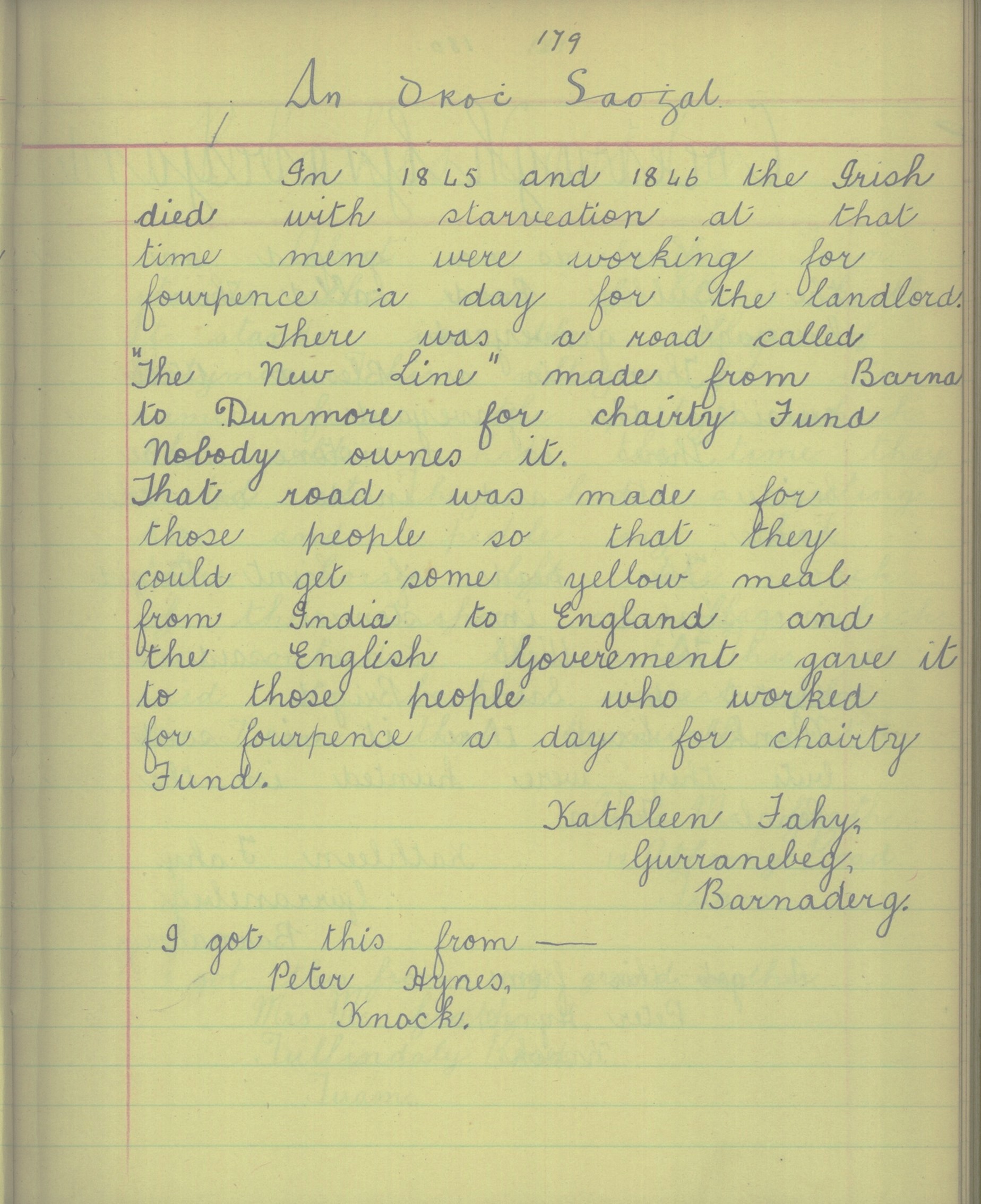
See in the attached photo taken from the 1937 School’s Folklore collection written
by Kathleen Fahy, Gurranebeg.
[1] Freeman’s Journal, 16 July 1942 “Correspondence between the Archbishop of Tuam and Lord Eliot”
[2] Tuam Herald, 24 Apr 1847.
[3]Photograph in possession of Brid Fahy, Peak
[4] Tuam Herald, December 1847.
[5] ibid
[6] Freeman’s Journal, 2 Oct 1845.
[7] Tuam Herald, 7 October 1848.
[8] ibid
[9] The Workhouse, ‘Story of an Institution’, (http://www.workhouses.org.uk/Tuam/), (10 May 2013).
[10] ibid
[11] Connaught Tribune, 15 Feb. 1985.
[12] Ibid.[13]
[13] The Galway Reader, Spring 1849, Vol 1.
[14]Travel Through Ireland, ‘’Settlement in Ireland’, (http://www.wesleyjohnston.com/users/ireland/geography/settlement.html), (20 Mar 2013).
No Comments
Add a comment about this page