
Famine in Killererin
Our Famine in 1847
Fr. John McLoughlin, P.P., Killererin sent a report on the Famine conditions in the parish to the Bishop’s ‘Destitution Census’ for their meeting at Loughrea in 1847, stating that there were 2,188 people in the parish and 772 were ” actually starving” (The Freeman’s Journal, 19th November, 1847).
Fr. McLoughlin was the priest responsible for building our church .
Famine in Killererin
The famine of 1847 was not the first to ravage the country. Throughout the 1700s the country experienced a number of famines. The failure of the potato crop and the scale of distress, sickness and death experienced during the 1840s led to the famine event of 1847 to become known as “The Great Famine” and it was one of the most devastating experiences of that period. A later famine event occurred in the 1880s and again plunged the west of Ireland into a period of distress and hunger.
The Famine in the West
On 16th July 1842 the Freeman’s Journal reported correspondence between Archbishop John McHale and Lord Eliot using testimony of the Registered Magistrate for Tuam, Mr. Tomkin Brew Esq., seeking recognition by the British Parliament of the existence of famine in the area:
‘If one penny were to purchase a meal, hundreds could not procure that penny or labour to procure it. It is my solemn belief founded on their wasted visages, there are at this moment more than one thousand individuals whose brave existence for entire days is kept up merely by the thinnest sparkling of meal in messes of noisome vegetables’[1]
Famine Field, Peak
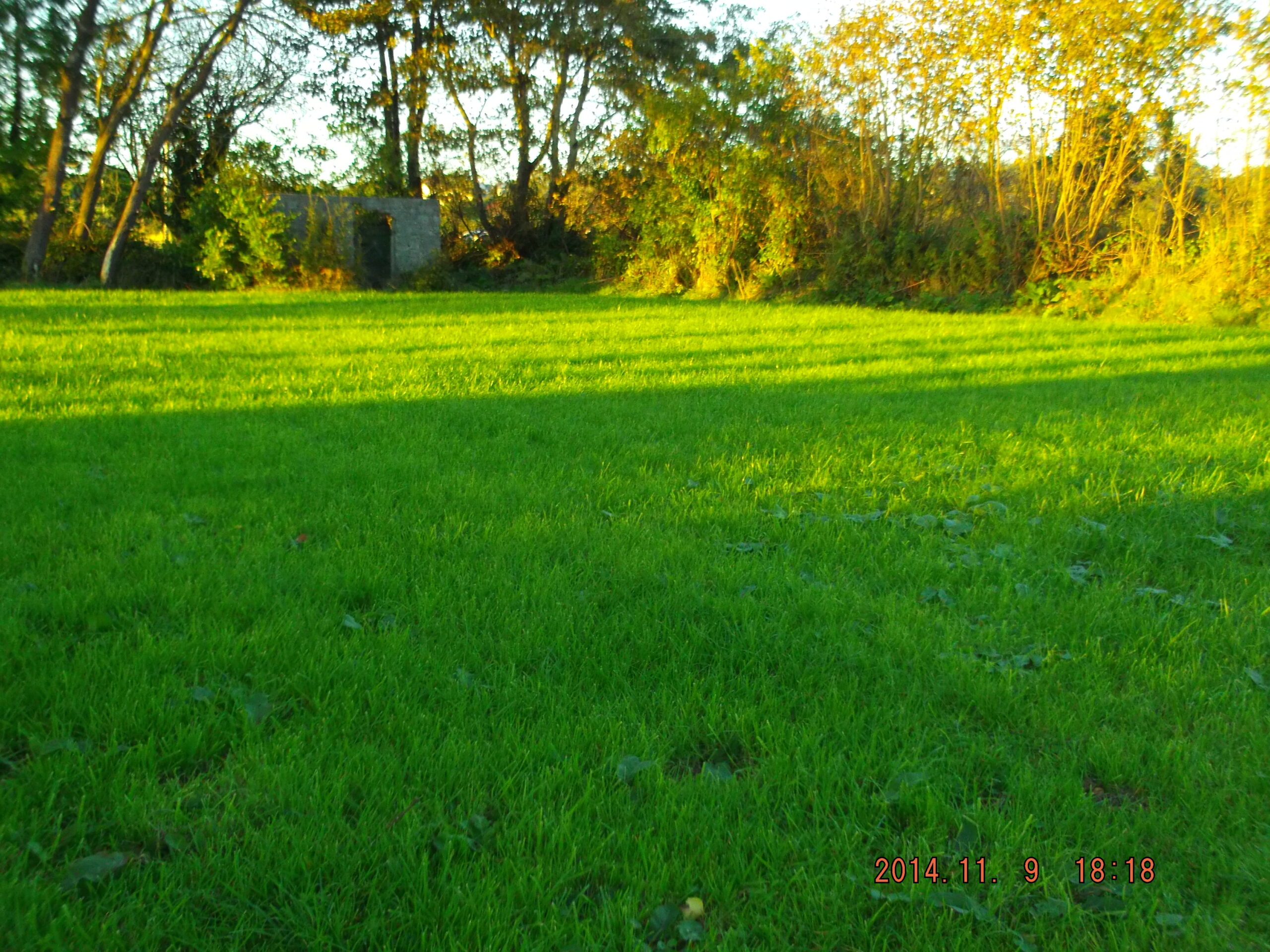
By January 1847, the town of Tuam was experiencing deaths by starvation and the spread of fever. The paper reported that ‘…in the Tuam Workhouse 77 people were down with fever and many more were down with dysentery and dropsy’.[2] In Killererin, the attached photograph shows a field where reportedly a 16 year old girl died from starvation. No one can say for sure if the girl was a local or from outside the Parish. It is said that the field hasn’t been tilled or ploughed in over 100 years.
Famine and Plenty living side-by-side
While an abundant harvest was expected for 1847 and indeed The Tuam Herald reported that ‘the Tuam Area has avoided the extreme ravages of the famine during the last half of the year[4] by February 1848 ‘at least 2,000 unfortunate beings were from an early hour in front of the Tuam Union Work house in the hope of getting admission…there are now 5,000 receiving relief in and out of the workhouse and fully 20,000 more in wait’.[5] Contradictions like this were evident throughout the reporting of the Famine. For example, on 2nd October 1845 the Freeman’s Journal reported on a cattle show in Ballinasloe where ‘…300 Gentlemen sat down at a banquet comprising all the choicest viands and the rarest delicacies of the sea and the wines including champagne and claret were the richest vintage and choicest aroma’.[6] As is often the case famine and plenty reigned side by side.
Potato crop fails again
In 1846 almost the entire potato crop failed. In 1847 only 2 million tons were harvested whereas 15 million tons were harvested in 1845.[7] By July 22nd 1848 the failure of the potato crop was once again reported in the papers and evictions were also becoming a typical sight on the Dunsandle estate around Athenry as ‘all who can fly are emigrating fast from the country’[8]
Two choices for people
Indeed during the 1840s only two paths existed out of the destitution experienced; either the workhouse or emigration. Most families in the USA, Australia, Canada, the UK or elsewhere can point to a branch of their genealogical tree where people originating in this parish left during the famine period. Some names have been included in a further chapter on ‘Emigration from Killererin’ detailing those who left in order to build a better life abroad.
The Workhouse
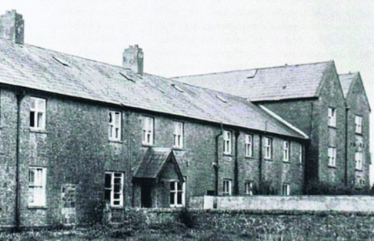
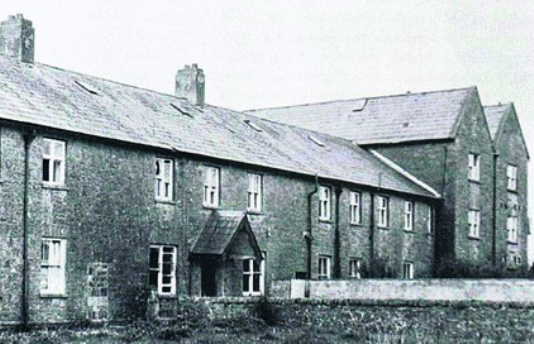
Conditions within the Workhouses were also miserable and often people fared no better inside than they had before admission. Tuam Poor Law Union was officially declared on 19th September 1839.[9] Its management was supervised by a Board of Guardians who included representatives from Abbey, Annaghdown, Cummer, Claretuam, Tuam, Clonberne, Donaghpatrick, Dunmore, Headford, Kilbannon, Monivea and Killererin. The Tuam Workhouse was built in 1841 on the Dublin Road on a 6 acre site and declared open for the reception of paupers on 15th August 1842.[10]
Extra sheds built at the Workhouse
During the famine period extra sheds were erected to house fever patients and others who crowded into the site. Records for the Tuam Workhouse have not been preserved so we cannot say who, from Killererin, might have sought succour there. In general because of conditions in the workhouses (which involved separation of families by gender) were very difficult involving hard labour, poor rations and the spread of disease. Few people volunteered to enter the Workhouse until all hope had failed. meals…approved by the Commissioners’.[11] Those admitted could not consume tobacco or liquor, paupers could only work on behalf of the Guardians
The Famine Relief Committee
In the National Archives, the following collection of letters from the Famine Relief Committee of Abbeyknockmoy and Killererin provides some local insight on the situation in Killererin during 1846 and 1847. A letter from Rev. William Le Poer Trench, Rector of Killererin enquired about the price of Indian Meal and where it might be procured and methods of cooking/preparing it.[15] This letter was sent to Captain Kennedy Relief Commission, Dublin Castle on 20th March 1846.
Lissavalley
Dangan
28th March 1846
Sir
I have been honoured by the receipt of a letter from you, accompanying the transmission of some printed documents, elucidatory of the various methods of preparing Indian Corn Meal as food.
As I am anxious as far as it may be in my power to do so, to co-operate with the particulars of the “Relief Commission”, in endeavoring to introduce the use of Indian Corn Meal as an article of food, among the peasantry, in the present emergency; you will oblige me by informing me where in Dublin Indian Corn Meal can be purchased, and at what price.
I have the honour to be sir
Your most obedient Servant
W. Le Poer Trench D.D.
Rector of Killererin
The following letter from John A. Kirwan, Landlord acknowledges receipt of regulations for the Poor Relief Committees and also tickets for work on the Relief Scheme. This letter is dated 4th July 1846.[16]
“Hillsbrook”
Dangan
Co. Galway
3rd July 1846
Sir
I would feel much obliged by your forwarding to me the regulations for Poor Relief Committees, also some parchment tickets for recommending people to get work etc. I have the honour to be
Sir
Your most humble servant
John Andrew Kirwan
D.l. & J.P
The Secretary of Relief Committee
Dublin Castle
Road Construction and Indian Meal
Amid the horrors of ‘Black 47’, the people lay dead in hundreds in the ways and in the fields. Daniel O’Connell, touched to the heart for his starving people, went to London to plead before Parliament for some relief aid to tide them over this terrible time. He succeeded in persuading the Government to grant 10 million pounds to be used in various kinds of relief work. The numerous grass grown unfinished roads throughout the country will give some idea of how the money was expended. The road from Daly’s cross through the bog at Cloonkeen to connect with the Abbert Road at Kavanagh’s bridge was lined and partly made from these relief funds. There were some fifty women as well as men working there.[17] Each woman was forced to carry a large basket something like the baskets used on donkeys into which three or four spits of turf were thrown by a man on the bank and carried to fill up hollows, where turf was cut sometime before.
Road construction at Derreen and Horseleap
Local knowledge would bear out the construction of roads at Derreen and Horseleap – to the village of Cloonkeen and leading to the old family home of O’Connell’s at Horseleap during the famine years. There may indeed be others. Francis Walsh was Secretary of the Relief Committee for Abbeyknockmoy and Killererin. His correspondence with the Secretary of the Board of Works, Dublin and with Mr. Stanley, Relief Commission Office, Dublin Castle, is shown below and mostly sets out requests for tickets for relief works and so on. On 17th August 1846 he requests ‘five hundred tickets for the Committee as those you sent have been given out. Request to say that the works will not suit the wants of the people’.[18] Again on 12th October 1846 receipts show that tickets were sent.
At that time Indian Meal was selling for 1d per stone and subsequently 2d per stone, £7 per cwt and £14 per cwt[19]. Letters of beseechment were being sent to the Committee from counties Antrim, Wicklow, Cork, Clare, Leitrim, Mayo and Donegal. Galway is not recorded but reports were supplied from all the Poor Law Unions and were similar in the information they provided. An extract from the Tuam Poor Law Union Report to the Sub-Inspector of Constabulary, in this case, John A. Kirwan, states that ‘the potato crop appears wholly affected by blight, in every part of the Union there is apprehension of want’.[20]
People faltering from hunger on the way to Tuam
Fr. Kieran Waldron in an article in 2002 drew together many aspects of life in the Parish during this time. He reports on a letter sent from Archbishop McHale to Lord Shrewsbury which states that:
…in the course of last week, within a short distance of Tuam – the Parish of Killererin, I was surrounded by a group of twenty persons, old and young some faltering from hunger as they approached; others with such miserable shreds of tattered clothes, that I am convinced they would have died under their roof – if roof they still had – rather than issue in such pitiable garb to expose themselves to the public gaze.’[21]
Sights like this became increasingly common as the effects of the famine became more established. The Archbishop went on to say that the people ‘shrieked with agony.[22]
Tuam Herald comments on death of Mary Cummin, of Dangan
The Tuam Herald during these years referred to an inquest held in Tuam Workhouse into the death of Mary Cummins of Dangan, Killererin who was ‘found dead on the road about 11.30; there were several women standing around the deceased; one of the women found 8 pence, a beads, a pipe and one penny worth of tobacco in her pocket’.[23] The verdict given on her death stated that she died from the effects of starvation and destitution ‘caused by a want of the common necessities of life’.[24] Archbishop McHale again wrote to the British Government in 1848.
Queue for admission to the Workhouse
In his letter to Sir John Russell he reported that ‘the cruelties committed in Ireland on the starving are scarcely equalled under the sun’[25]. It was reported that February 1848 was a very bad month in Tuam where ‘2,000 unfortunate human beings were from an early hour in front of the Tuam Union Workhouse in the hope of gaining admission’.[26] Many of the people were described as skin and bone with little or no clothing or any kind of possessions.
Another famine hits the Parish
The Great Famine of 1847 was followed by a number of other famine occurrences that affected the West of Ireland in particular. On 6th April 1878 the Nation referred to ‘the roofless homes of Irish peasants…the people seemed powerless to help themselves’.[27] In 1880 in fact, severe famine conditions prevailed again. There were 800 Committees set up with the aim of collecting monies locally from townspeople, tradesmen and landowners as well as from the Irish abroad in order to relieve distress. These were known as the Mansion House Relief Fund and local Committees could apply for funds to purchase Indian Meal.
Committee set up to work on behalf of people of Killererin
A Committee set up in Killererin worked diligently on behalf of the people of the parish. That correspondence is now preserved in Dublin City Library, Pearse Street and makes interesting reading. The members of the Committee, landowners and clergy are recorded and are a link to the past, documented for posterity. Requests, receipts and final accounts are set out here below. There was also a lesser fund known as the Duchess of Marlborough Fund from which £10 was spent on Indian Meal for 40 distressed families.[28] It was discovered that many more were in similar distress.
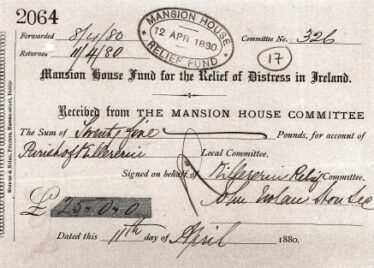
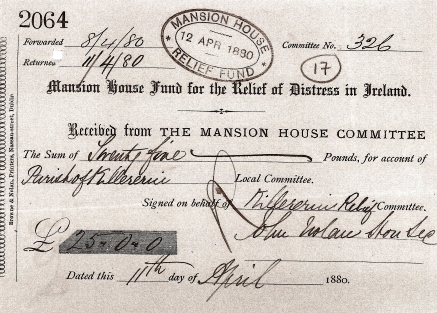
£25 from the Mansion Relief Fund to Killererin Relief Committee, April 1880
The Committee was very efficient in its applications for funds for the relief of this distress and in its provision of accounts to the Mansion House Committee. In this correspondence they set out the causes of famine in the area as threefold:
(1) The large number of small farmers and labourers were those mostly affected in the area
(2) Loss of the potato crop and
(3) Want of employment, at home and in England
In a letter of 15th February 1880 the Secretary states that ‘half the lands being of a wet, cold and marshy nature and consequently rotted utterly all the crops in the low-lying lands’[29]. There were 300 families in distress and £100 was sought at once while only £50 was received according to a receipt of 17th February 1880.[30] On 29th February more relief money was sought on the basis that ‘307 families, 1611 persons and likely to increase’ were in distress.[31] A further £25 was received on the 11th of April the Committee having been told to reapply for 3 weeks following 13th March. By 6th May 1880 matters were escalating with 323 families, 1696 persons in need.
On 9th May that year the Rev. Patrick Waldron PP Killererin stated that, ‘I think you will agree that 2 stones of meal for 15 days is not an extravagant allowance’.[32] He later stated that ‘our people are killing their hens and ducks to keep them alive …I have 3 villages in which there are 100 people and they haven’t a particle of food’.[33]
£25 from the Mansion Relief Fund to Killererin Relief Committee, May 1880
Starvation is a slow and torturous death. The people of Killererin may have been helped to survive due to the relief provided by this Committee which seems to have laboured consciously on their behalf. The Mansion House Committee was discontinued in late August 1880.[34] In 1880 the members of the Committee were[35]: Chairman: Rev. Patrick Waldron PP, Secretary; John Nolan, Garra, Ballyglunin, Treasurer: Major David Ruttledge, Barbersfort, Tuam. The Members of the Committee were recorded as: Rev. Patrick Waldron, P.P., Rev. W. J. Clarke, Protestant Minister, Major David, Rutledge, J.P. Land Proprietor, Robert Henry, J.P. Landed Proprietor and Land Agent, Maxwell J. Boyle, Barony Constable, Martin J. Blake, Farmer and Grazier, Captain S. Waithman, Land Agent, John Nolan, Proprietor and Farmer, Mr. John Hanly, Farmer, Mr. Patrick Whelan, Farmer.
Mansion House Relief Fund – Killererin Relief Committee Members’ Details
The Consequences for Killererin
Oral tradition is very limited as far as the Famine is concerned. Nobody wanted to remember the shame and terror of fighting for survival against starvation and disease. “The Great Hunger” or “An Gorta Mór” is something emigrants found difficult to remember even in story or in song. One verse from ‘Poor Pat Must Emigrate’ reflects the sadness and anger of hunger, disease and ultimately departure from Ireland.[36]
If they’d leave us our cabins
Where our fathers drew their breath;
But when they’d come upon rent day
And you have no half-pence for to pay,
Faith, they’d drive you out of house and home
To beg or starve to death.
What kind of treatment, boys, was that,
To give to poor, honest, Irish Pat?
To drive his family to the ditch
To beg or starve to death!
But I rose up with heart and hand,
And sould [sic] my little spot of land;
That’s the reason, boys, I’ll tell you now
I was forced to emigrate[37]
If they managed to leave their hunger and their country behind they were consumed by a new hunger; that of survival and the achievement of prosperity for themselves and their descendants. Perhaps now, that a century and a half and several generations has passed it is the right time to look back. Even though Tuam Workhouse which may have housed many people from the Parish has been razed to the ground, we endeavour to remember in this book, all those from the area who succumbed to hunger or who left our parish in the most desperate circumstances.
[1] Irish Newspaper Archives, ‘Correspondence between the Archbishop of Tuam and Lord Elliot’ (http://www.irishnewsarchive.com/Default/Scripting/ArticleWin.asp?From=Search&Key=FMJ/1842/07/16/3/Ar00301.xml&CollName=FMJ_1841_1860&DOCID=207976&PageLabelPrint=3&Skin=INA&enter=true&AppName=2&AW=1369657060375&sPublication=FMJ&sScopeID=DR&sSorting=Score%2cdesc&sQuery=distress&rEntityType=&sSearchInAll=false&sDateFrom=%2530%2537%252f%2531%2535%252f%2531%2538%2534%2532&sDateTo=%2530%2537%252f%2531%2536%252f%2531%2538%2534%2532&ViewMode=HTML) (5 May 2013).
[2] Tuam Herald, 24 Apr 1847.
[3] Who owns this photo? – add footnote when we found out
[4] Tuam Herald, December 1847.
[5] ibid
[6] Freeman’s Journal, 2 Oct 1845.
[7] Tuam Herald, 7October 1848.
[8] ibid
[9] The Workhouse, ‘Story of an Institution’, (http://www.workhouses.org.uk/Tuam/), (10 May 2013).
[10] ibid
[11] Connaught Tribune, 15 Feb. 1985.
[12] ibid.
[13] The Galway Reader, Spring 1849, Vol. 1.
[14] Travel Through Ireland, ‘’Settlement in Ireland’, (http://www.wesleyjohnston.com/users/ireland/geography/settlement.html), (20 Mar 2013).
[15] NAI, RLFC/3/1/832, Relief Commission Letter, 20 Mar 1846.
[16] Geraldine – do you have the file reference for this, if so add as for footnote no. 15
[17] Geraldine – do you have the file reference for this, if so add as for footnote no. 15
[18] NAI, RLFC/3/1/5289, Relief Commission Letter, 17 Aug. 1846.
[19] NAI, RLFC/3/1/5576, Relief Commission Tuam Poor Law Union, 1846.
[20] NAI, RLFC/3/1/5576, Relief Commission Letter, 20 Aug. 1846.
[21] Fr. Kieran Waldron, ‘A Recent Famine in Killererin’, Out and About Magazine, 2002, pp. 28-30.
[22] ibid
[23] ibid
[24] ibid
[25] ibid
[26] ibid
[27] Irish Newspaper Archives, ‘The Nation’ (http://www.irishnewsarchive.com/Default/Scripting/ArticleWin.asp?From=Search&Key=NAT/1878/04/06/7/Ar00701.xml&CollName=NAT_1861_1880&DOCID=128388&PageLabelPrint=7&Skin=INA&enter=true&AppName=2&AW=1369657060375&sPublication=NAT&sScopeID=DR&sSorting=Score%2cdesc&sQuery=roofless&rEntityType=&sSearchInAll=false&sDateFrom=%2530%2534%252f%2530%2535%252f%2531%2538%2537%2538&sDateTo=%2530%2534%252f%2530%2536%252f%2531%2538%2537%2538&ViewMode=HTML) (12 May 2013).
[28] Letter to John Nolan from The Secretary, Mansion House Committee, 2 Jan. 1880, (Dublin City Library and Archive, Mansion House Relief Fund, Local Relief Committee No. 26).
[29] Letter to The Lord Mayor, Dublin Mansion House Committee, 14 Feb. 1880, (Dublin City Library and Archive, Mansion House Relief Fund, CH1/52/326, Local Relief Committee No. 26).
[30] Letter to The Lord Mayor, Dublin Mansion House Committee, 24 Feb. 1880, (Dublin City Library and Archive, Mansion House Relief Fund, CH1/52/326, Local Relief Committee No. 26).
[31] Letter to The Secretary, Mansion House Committee, 29 Feb. 1880, (Dublin City Library and Archive, Mansion House Relief Fund, CH1/52/326, Local Relief Committee No. 26).
[32] Letter to The Secretary, Dublin Mansion House Committee, 9 May. 1880, (Dublin City Library and Archive, Mansion House Relief Fund, CH1/52/326, Local Relief Committee No. 26).
[33] Letter to The Lord Mayor, Dublin Mansion House Committee, 18 May 1880, (Dublin City Library and Archive, Mansion House Relief Fund, CH1/52/326, Local Relief Committee No. 26).
[34] Letter to The Lord Mayor, Dublin Mansion House Committee, 18 May 1880, (Dublin City Library and Archive, Mansion House Relief Fund, CH1/52/326, Local Relief Committee No. 26).
[35] Mansion House Relief Fund Committee Killererin, 1880, (Dublin City Library and Archive, Mansion House Relief Fund, CH1/52/326).
[36] L. Perry Curtis Jr., The Depiction of Eviction in Ireland 1845-1910, (Dublin, 2011), p. 111.
[37] Geraldine footnote/source for this?
No Comments
Add a comment about this page